
Project Vision
The Campus Wetterstation at Hochschule RheinMain (Campus "Unter den Eichen") is a long-term research initiative at the intersection of IoT, Cloud Computing, and Sustainable Energy. The goal was to create a professional-grade meteorological station that is not only fully integrated into the university's modern cloud infrastructure but also capable of operating 100% energy autonomously year-round.
What began as a foundational study has evolved into a sophisticated "Green IoT" reference project, demonstrating how intelligent software can overcome hardware limitations in off-grid scenarios.

Academic Timeline & Team
The project spans three academic semesters, with each phase building upon the lessons of the last:
Phase 1: Foundation & Cloud Integration
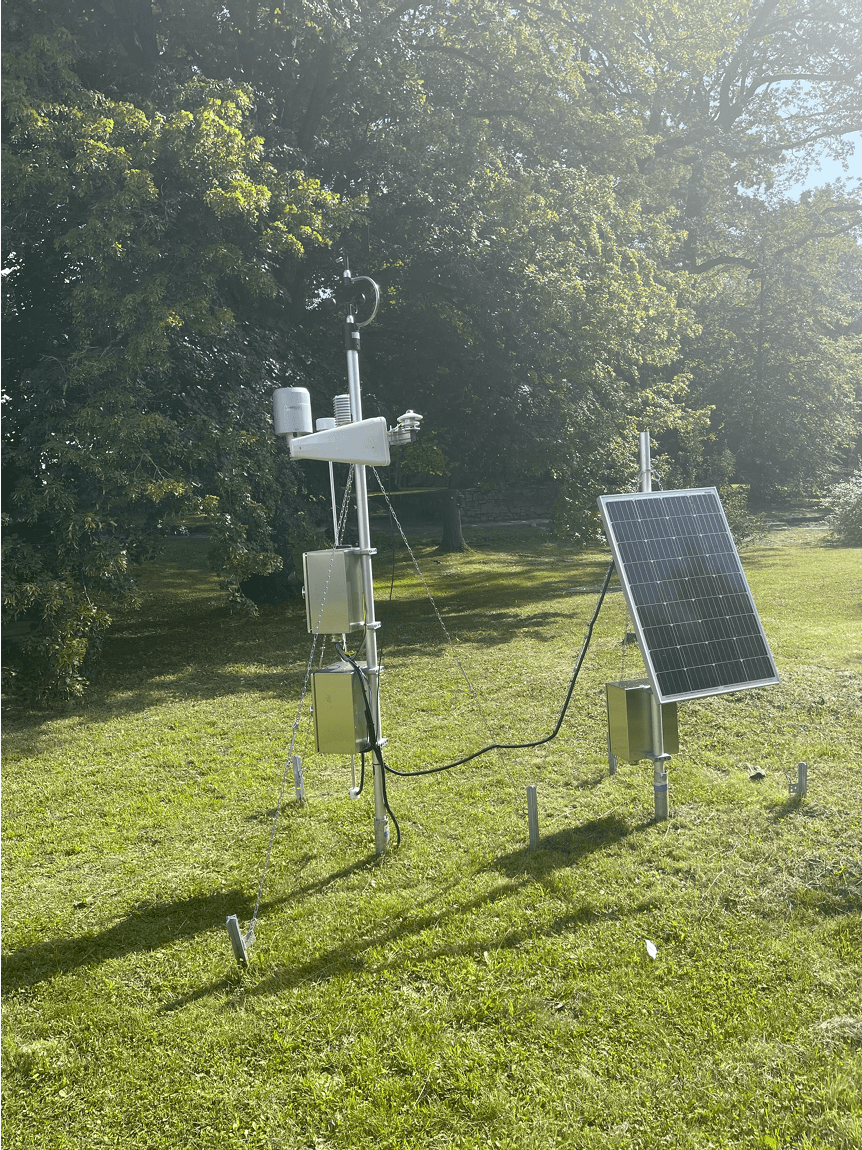
- Context: Bachelor Thesis (Sommersemester 2024)
- Author: HSRM Student
- Supervisor: Prof. Dr. Holger Hünemohr
- Focus: Establishing the physical station, sensor integration (Ser[LOG]), and creating the initial data pipeline.
- Key Challenge Identified: The initial 100W solar setup was insufficient for reliable winter operation.
Phase 2: Restoration & Energy Management
- Context: Master Project (Sommersemester 2025)
- Authors: Holger Albrich & Ahmed Sharhan
- Supervisor: Prof. Dr. Holger Hünemohr
- Focus: Reviving the station after hardware failure, replacing batteries with Li-Ion technology, and implementing the first Energy Management System (EMS) using Node-RED and Grafana to visualize power flows.
- Key Challenge Identified: The standard network hardware (Router) consumed too much power, preventing true autonomy.
Phase 3: Autonomy, Reliable Datamanagement & Public Visualization
- Context: Master Project (Wintersemester 2025/26)
- Authors: Jan Kretschmar & Nicolas Moeller
- Supervisors: Prof. Dr. Holger Hünemohr & Prof. Dr. Nikolay Tcholtchev
- Focus: Achieving 99.9% winter availability. This involved a complete redesign of the power architecture (DC-Bus topology, 510Wp Solar, 1536Wh Storage) and the development of an intelligent "Low-Power Mode".
- Achievement: Reduced outage probability in December from ~40% to 0%. Development of this public website to visualize live data.
Parallel Research Track: 5G Campus Network
- Context: Master Project (Wintersemester 2025/26)
- Authors: Lukas Kahl & Jens Hummel
- Supervisor: Prof. Dr. Holger Hünemohr
- Focus: Design of a holistic Private 5G Standalone (SA) campus network architecture. The weather station served as a primary "Green IoT" use case to evaluate 5G RedCap technology for energy-critical applications, alongside high-bandwidth scenarios like drone inspections.
- Key Insight: A private 5G network with industrial RedCap routers (Teltonika RUT976) can operate with extremely low power (~0.5W avg) using interval strategies, offering a robust alternative to WLAN.
Technical Highlights
- Hardware: Trina Solar 510Wp, Victron LiFePO4 Storage, Lambrecht meteo Sensors.
- Software: Docker-based backend with MQTT, InfluxDB, Node-RED, and Grafana. Local buffering via SQLite ensures data integrity during connectivity drops.
- Smart Energy: The station automatically switches between "Normal" and "Low-Power" modes based on battery state (SoC) and solar forecast, ensuring data is never lost even during weeks of darkness.
Current Status
As of February 2026, the station is fully operational and validates its design through daily field data. It serves as a living lab for students and researchers to study off-grid system dynamics and micro-climate patterns on campus. Parallel research into 5G Standalone connectivity provides a clear roadmap for future infrastructure resilience upgrades.