
Abstract/Goal
The main objective of this thesis was to design, construct, and commission an automated weather station on the "Unter den Eichen" campus of the RheinMain University of Applied Sciences (HSRM). The project aimed to integrate this station into a modern IT architecture (building upon previous "Smart Greenhouse" and "Datenraumwald" projects) to securely store weather data in the HZD (Hessische Zentrale für Datenverarbeitung) research cloud.
A key focus was on using Open Source software to ensure digital sovereignty and designing a robust Energy Management system to guarantee year-round autonomous operation via solar power.
Station Location & DWD Conformity
The station is located on a level grass field near Building B1 on the "Unter den Eichen" campus. The site selection was based on the guidelines of the German Meteorological Service (DWD) for auxiliary stations (nebenamtliche Wetterstationen).
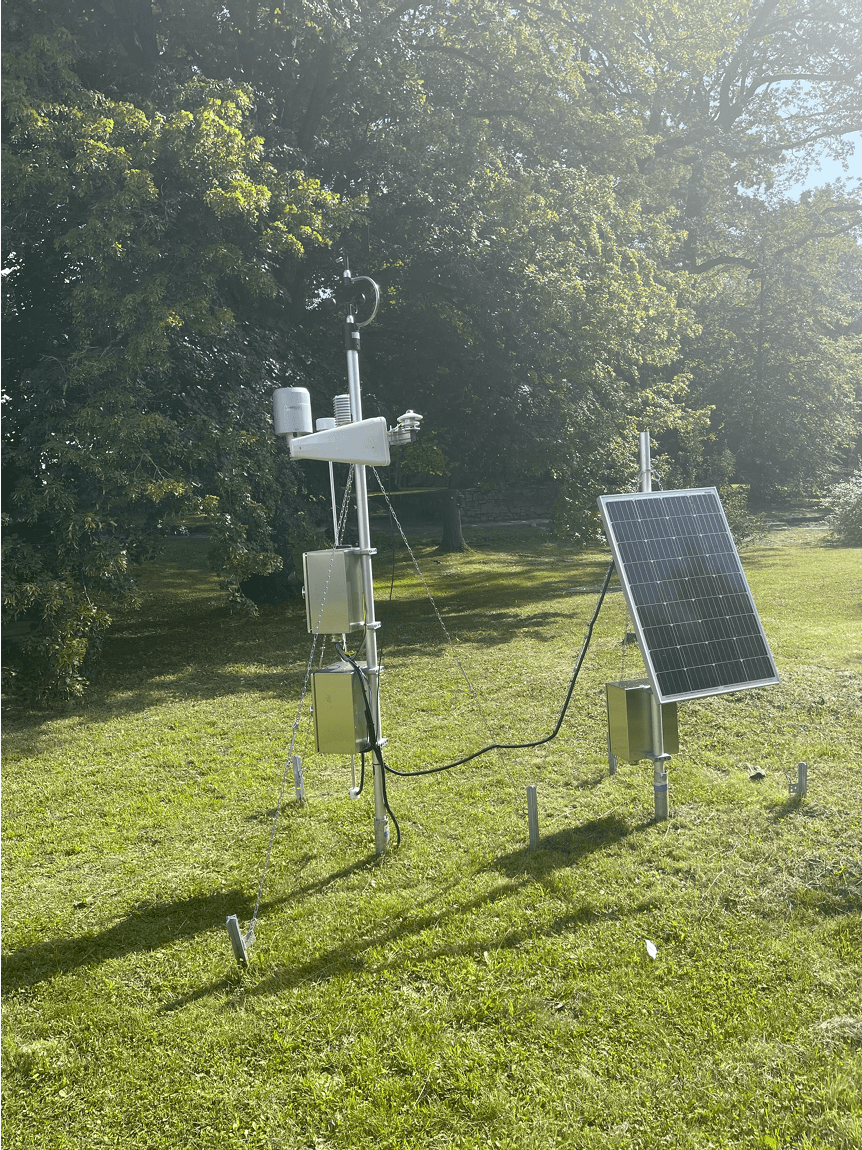
Compliance Status: "Almost DWD Conform"
The station fulfills most DWD requirements for a standard measurement field:
- Ground: Level, grass-covered surface (standard reference).
- Interference: Far from immediate heat sources, moisture vents, or electromagnetic interference.
Deviations: However, strict DWD conformity is not achieved due to the specific campus environment:
- Obstacles (Shading): The surrounding trees and buildings violate the strict distance rules for obstacles. Specifically, a large tree to the southwest casts a shadow on the global radiation sensor between 15:30 and 16:30, causing a dip in measurement values.
- Sensor Height: While the primary air temperature is measured at standard height, the secondary soil-level sensor is placed at 20 cm (relevant for agriculture/campus use) instead of the strict DWD standard of 5 cm.
Detailed Sensor Specifications
The station is equipped with high-precision sensors connected to a Ser[LOG] Plus data logger from Lambrecht meteo GmbH.
| Sensor Type | Model / Manufacturer | Measurement Principle | Range | Accuracy / Notes |
|---|---|---|---|---|
| Data Logger | Ser[LOG] Plus (Lambrecht) | Central Data Collector | N/A | High connectivity, low power |
| Precipitation | Joss-Tognini-15189 (Lambrecht) | Tipping Bucket (Kippwaage) | 2/4 cm³ buckets | ±2% accuracy; heated for winter |
| Global Radiation | CMP3 (Kipp & Zonen) | Pyranometer (Thermopile) | 0–2000 W/m² | ISO 9060 Class C; spectral range 300–2800 nm |
| Wind Speed | ARCO-Serial (Lambrecht) | Cup Anemometer | 0.3 – 75 m/s | ±2% accuracy; robust against gusts |
| Wind Direction | ARCO-Serial (Lambrecht) | Wind Vane | 0° – 360° | ±1° accuracy |
| Air Temperature | PT-1000 (Hoffmann) | Resistance (Ventilated) | -20°C to +70°C | ±0.2°C; ventilated housing to prevent heat buildup |
| Humidity | Capacitive Sensor (Hoffmann) | Capacitive Polymer | 5% – 100% r.H. | ±1.5% accuracy (5–95% range) |
| Soil Temperature | PT-100 (Hoffmann) | Resistance Probe | -20°C to +70°C | ±0.2°C; buried at depth |
| Leaf Wetness | Kapazitiver Fühler (Hoffmann) | Dielectric Constant | 0% (dry) – 100% (wet) | Detects dew and precipitation duration |
System Architecture
The IT architecture ensures secure data transmission from the field to the cloud:
-
Field Level (The Station):
- Sensors -> Ser[LOG] Plus Logger.
- Logger transmits data via MQTT protocol over a local TP-Link Router (running OpenWrt).
- Power: 100Wp Solar Panel + 60Ah LiFePO4 Battery (Victron Energy).
-
Gateway Level (University VM):
- Mosquitto Broker: Receives raw MQTT messages.
- Node-RED: Processes data, adds metadata, and forwards to the cloud.
- InfluxDB: Provides temporary local storage for redundancy.
-
Cloud Level (HZD Research Cloud):
- Kubernetes Cluster running the Stackable Data Platform.
- Apache Kafka: Ingests high-throughput data streams.
- Apache Druid: Stores data for real-time analytics.
- Apache Superset: Visualizes data on dashboards.
Results & Conclusion
- Successful Commissioning: The station was successfully installed and integrated into the complex HZD cloud architecture using almost exclusively Open Source software.
- Energy Analysis: A key finding was that the 100W solar panel is insufficient for December, where energy production drops below the system's daily consumption. This necessitated the "Low-Power" strategies explored in later master projects.
- Data Quality: Despite the shading issue, the data quality is high and comparable to professional stations, providing valuable micro-climate data for the campus.