
Focus/Goal
The primary goal was the energetic upgrading of the existing campus weather station to achieve year-round energy autonomy. The project addressed the issue of power failures during winter months (low solar irradiance) by analyzing existing deficits and developing a new system architecture.
A key focus was determining if hardware expansion alone is sufficient or if load management is also required. Additionally, the project included the development of a project website to visualize the station's data and status for the public.

Detailed Energy Concept
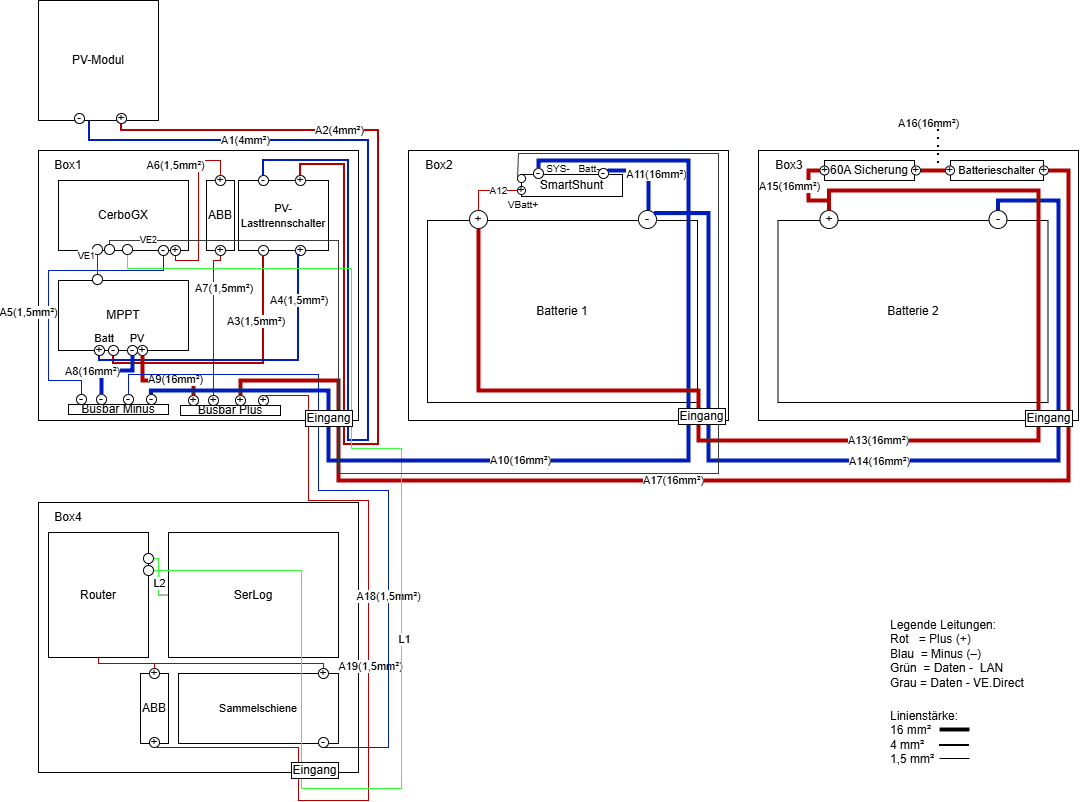
The new energy concept moves from a simple direct supply to a robust DC-Bus topology where energy flow and communication flow are logically separated.
Load Profiles (Tabelle 2)
The paper analyzed the daily energy consumption in two modes:
| Mode | Active Components | Daily Consumption (Wh) | Avg Power (W) |
|---|---|---|---|
| Normal Mode | Full operation (Router, Sensors, Cerbo GX) | 448.80 Wh | 18.70 W |
| Low-Power Mode | Reduced operation (Non-critical off) | 241.08 Wh | 10.05 W |
(Note: Low-Power Mode reduces consumption by ~46%)
Outage Probability (Tabelle 3)
Based on PVGIS simulations for the specific location (Latitude 50.095°, Longitude 8.217°):
| Month/Metric | Outage Probability (Normal Mode) | Outage Probability (Low-Power Mode) |
|---|---|---|
| December | 38.5% (Critical) | 0% (Safe) |
| January | 29.2% | 0% |
| Mar / Oct | < 1% | 0% |
| Apr - Sep | ~ 0.0 - 0.2% | 0% |
| Annual Avg | 7.48% | 0% |
Hardware Implementation Specs
To achieve these results, the hardware was significantly upgraded:
- PV Generator: Trina Solar Vertex S+ (510 Wp). A massive upgrade from the previous 100Wp panel.
- Storage: 2x Victron LiFePO4 SuperPack (12.8V / 60Ah each = 120Ah total).
- Total Capacity: 1536 Wh.
- Voltage: 12.8 V nominal.
- Charge Controller: Victron SmartSolar MPPT 100/50 (Handles up to 50A charging current).
- Monitoring:
- Victron Cerbo GX: Central communication center.
- SmartShunt 500A: Precise battery monitor (Voltage, Current, SoC).
- Cabling: Upgraded to 16 mm² cross-section to minimize voltage drop.
Software & Data Flow
The project introduced intelligence into the energy management system and a new data pipeline for the website:
- Dual Operating Modes:
- Normal Mode: Continuous full operation of all sensors and communication.
- Low-Power Mode: Activated when battery SoC or solar input drops below critical thresholds. Prioritizes data logging over real-time transmission or non-essential sensors.
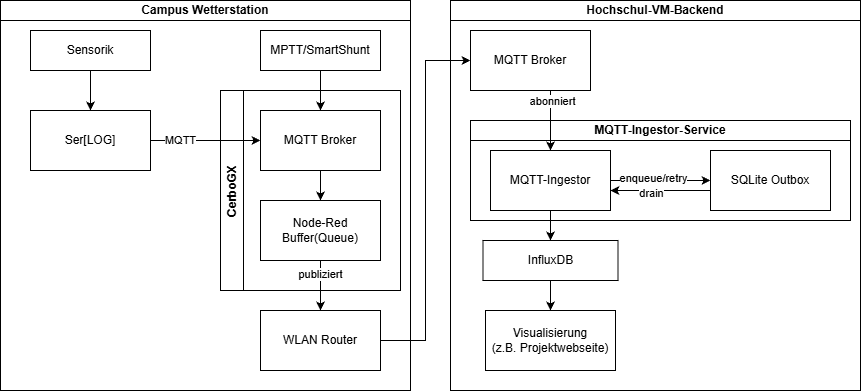
- Monitoring Pipeline: Parallel MQTT streams now transmit both meteorological data (via Ser[LOG]) and energy data (via Cerbo GX) to the backend (InfluxDB/Grafana).
- Website Integration: A custom web interface was developed to display live data from the InfluxDB backend, making the station's status accessible to the campus community.
Field Validation (Tabelle 4)
An initial 72-hour field test (Feb 13–15, 2026) validated the simulation models. The data shows stable operation even on low-light days (Feb 14).
| Metric | 13.02. (Sunny) | 14.02. (Cloudy) | 15.02. (Mixed) |
|---|---|---|---|
| SoC Range | 93.2% – 100% | 93.1% – 100% | 93.9% – 100% |
| PV Max Power | 412 W | 116 W | 181 W |
| Charging Energy | 440.2 Wh | 135.2 Wh | 211.2 Wh |
| Discharge Energy | 116.2 Wh | 135.9 Wh | 125.5 Wh |
| Net Balance | +324.0 Wh | -0.7 Wh | +85.7 Wh |
- Feb 14 Analysis: Even on a "dark" day with only 116W peak power, the system maintained a neutral balance (-0.7 Wh), proving the efficiency of the base load configuration.
Results & Conclusion
- Autonomy Achieved: The combination of hardware expansion (510Wp PV + 1536Wh Battery) and the Low-Power strategy effectively eliminates winter outages.
- Winter Challenge Solved: The outage probability in December drops from a critical 38.5% to a safe 0%.
- Methodological Conclusion: For high-availability off-grid systems in temperate climates, massive hardware oversizing alone is less effective than combining reasonable hardware sizing with intelligent demand-side management.